Pawpaw wine, tomato wine... It's been a lively season, and for two more weeks I still live in a barn but there are big movements to follow. Read or refresh yourself on How I Came to Live in a Barn (scroll to bottom), so you are prepared to find out what's next. Hint: it rhymes with "officially starting the farm." Too cryptic? No worries, it will all be revealed in due time.
Always sucked at ryhming,
Fraust
Showing posts with label Bugtussle. Show all posts
Showing posts with label Bugtussle. Show all posts
Sunday, October 30, 2011


Friday, March 18, 2011
How I Came to Live in a Barn: Part 7
Ladies and gentlemen, you've made it––or you've cheated, respectfully––but either way, you've arrived! This marks the seventh and final installment of "How I Came to Live in a Barn," the series that strives to connect drinking to farming as relevantly as humanly possible.
If you're just tuning in, as a quick preface to this series, from April to December of 2010 I lived in a barn. No electricity, running water, losses to Morehead State in the first round of the tournament (Sorry, Cards fans), or losses to West Virginia in the second (Let's go, Jorts!). During that time I worked on a legitimately (though proudly uncertified) organic farm in Southern Kentucky. This series is about the many whims, fascinations and revelations that eventually inspired me to drop everything and go farming. This preface appeared at the beginning of the entire series, so I guess this marks the end of that, too. sad-face emoticon. Anywho, y'ready? Wunderbar

You know how they say, "Don't put all your eggs in one basket?" Well, anyone who says that simply isn't romantic enough for me to listen to. I liked what I'd read about the place and confidently, I put all of my eggs in the their basket, never once looking back.
I learn best by experience, so immediately I ruled out going to farm school. I'd found Bugtussle on the internet, wishfully searching for biodynamic farms in and around Kentucky. Luckily, being the lush-ass area it is, natural farms abound in this part of the country. One word in particular appeared regularly in my searches––"Bugtussle"–– and the more I read about the place, the more it appealed to me. I wanted a farm either close to Louisville or close to Nashville; I wanted it to be diverse including both animals and vegetables; and I wanted to learn from someone doing something similar to what I wanted, and time and time again, my search results rendered the same farm.

Hoping for the best, I filled out the application, sent it off, crossed my fingers, and waited anxiously. I was in the book store when the phone rang and it was Bugtussle. Running out onto the busy streets that surround Union Square I nervously chatted with Eric over the sirens and horns. I couldn't believe how nervous I was, but I was also happy to be so; it meant I wanted this gig bad enough to know I could screw it up. We got along well, and he said that they required a farm visit before they could take anyone on, which I suspected, was fine with, and prepared for. After we got off the phone I booked myself a trip to Nashville, and this was that farm visit.
 The driveway is a solid quarter mile of rocky dirt road, distinguished in the forest by a single, hand-made cedar mailbox. It looks nothing like any farm I'd ever entered. Guided by a thick tunnel of trees, you cross two low water fords––low most of the time. About halfway in, you pass a high tunnel on the left now, however at the time I passed its skeleton. There was a cow in my path that moved along unconcerned and leaped back into the neighbor's pasture when it saw me. As I pulled down the driveway, I could see smoke billowing out from the cabin's chimney, an outdoor kitchen and a stack of shiitake logs that told me I had chosen the right driveway in the middle of nowhere. Whew.
It didn't take long for me to warm up to the family. Eric and Cher are welcoming, intelligent, and curious, as are their 3 children. Eric and I had already spoke on the phone many times, and I had read most of what he'd recommended, including Joel Salatin's "Everything I Want to do is Illegal," and Gene Logsdon's "The Contrary Farmer" among others. We had some lunch, then set out to do chores––moving the livestock and such––then headed back down the hill to the house to warm up. It was January, and it was cold. That night it was supposed to get down to 20 degrees, and I can attest to the fact that it definitely did so.

He started me a fire in the wood-stove in the barn, where I'd be staying. My space is two rooms––one up, one down––a desk (down) and a bed (up). That's about it, besides the cookstove which was what I had to rely on for heat, that, and my ability to keep a fire going, or lack there of. At first, it was raging hot, then it was raging cold, and it stayed that way until 5:00am when Eric came over to the barn to get me. We had to move the chickens before sun-up, I was a solid block of ice. Despite my sleeping bag, layers and long-johns, it was still the coldest night of my life. I had failed at bundling, or keeping the fire going, two things I could do proficiently in New York (where the landlord keeps the fire going by law). Needless to say, when Eric came to get me, I was excited to get the blood flowing.
 After we moved the chickens, we headed down to breakfast. Eric always says that you feed the animals before you feed yourself, and we never strayed from that. After some oats and fresh maple syrup, we tackled a few things on the farm––there was a snow storm coming and though he never feeds his livestock hay, he didn't want to starve them if the grass was inaccessible. So I tossed him bales for the first time in my life, and it was truly (and and little sadly) difficult. I lacked any and all form of farm muscle, the baling twine slicing through my soft, wine-shop-reared hands, and the simple act of tossing a bale off of a stack from about twenty feet up was just about enough motion to send me with it. Farming, he would tell me, is the materials handling business. I learned on the farm that you move a bunch of stuff around all day long and somehow, at the end of the week, food pops out. It's physical, then it's a miracle.
For lunch that day we had roasted pork with sweet potatoes and kimchi––all from the farm. I sat there at the table quiet, admittedly more exhausted than I wanted to admit. Eric ran out of the house and returned with a bottle from the cellar and sat it next to me. "Persimmon wine" he said, and smiled. This, I have to say, was the proverbial moment I moved into the barn. I made the kids a plate, then Cher, then Eric, then myself. Eric poured the wine. They wanted to know what I thought, and I, being a nerdy wine nerd, couldn't wait to taste it. It was unctuous, slightly oxidized and a little funky: like riesling, sherry and pears all had a feral son and it was called Persimmon Wine. And it was great. Alongside the pork roast, it was perfect even. I was elated, and (way too) excited that they drank––a legitimate fear I had going into this farming world. After lunch, they offered me the internship and they offered me that room in the barn if I wanted it. I said yes to both, then the six-year-old introduced me to all 200 hundred of his fish paintings and we spent the rest of the evening hanging out.

When I left, I took with me both soreness and enthusiasm as a souvenir. I also took with me the fact that this was going to be harder than it was in my dreams. The gravity of moving away from New York City was compounded by the gravity of how incredibly different this lifestyle would be. And how incredibly difficult. And not just for a few days like this farm visit was, but nearly 8 months to a lifetime. Between the food, and the wine, and the return to my homeland, however, it all spoke to me. I had no idea if I was going to survive it, but I was sure as hell going to give myself a chance to die trying. That April, after nearly four years at September, three and a half years after my obsession with natural wine, and a year and a half after Hervé and Éric, I was moving into my barn. I passed 8 hard fought months in that barn, through the heat, the cold, the bugs and the bites, and come April 6th of this year, I'll be fighting 8 more, eating like a king daily. When Eric offered me a second year internship, I couldn't resist. The first year I dedicated to the experience, but I still have a long way to go. The second year will be dedicated to the education, which I'll do my best to apply to the rest of my life.
I like to think that my family––generations from now––will look back fondly on the story of how crazy ol' Grandpa Fraust decided to go farming all those years ago. Hopefully they will be reminiscing over a glass of persimmon wine, or paw paw wine, or blueberry wine from the farm I willed them, and hopefully they will still be farming it. Even if I didn't really have a damn clue how to farm when I moved into the barn, and it wasn't in my family to do so, I knew it had to start somewhere, right?
So that, my friends, is how crazy ol' Grandpa Fraust came to be, came to Kentucky and came to live in a barn. In a weird little nutshell.
I want to thank you all for reading, and to say go Cats (sorry, it's March, but seriously, go Cats!)! Thank you, and happy growing.
-Fraust
If you're just tuning in, as a quick preface to this series, from April to December of 2010 I lived in a barn. No electricity, running water, losses to Morehead State in the first round of the tournament (Sorry, Cards fans), or losses to West Virginia in the second (Let's go, Jorts!). During that time I worked on a legitimately (though proudly uncertified) organic farm in Southern Kentucky. This series is about the many whims, fascinations and revelations that eventually inspired me to drop everything and go farming. This preface appeared at the beginning of the entire series, so I guess this marks the end of that, too. sad-face emoticon. Anywho, y'ready? Wunderbar
How I came to Live in a Barn: The Barn edition

You know how they say, "Don't put all your eggs in one basket?" Well, anyone who says that simply isn't romantic enough for me to listen to. I liked what I'd read about the place and confidently, I put all of my eggs in the their basket, never once looking back.
I learn best by experience, so immediately I ruled out going to farm school. I'd found Bugtussle on the internet, wishfully searching for biodynamic farms in and around Kentucky. Luckily, being the lush-ass area it is, natural farms abound in this part of the country. One word in particular appeared regularly in my searches––"Bugtussle"–– and the more I read about the place, the more it appealed to me. I wanted a farm either close to Louisville or close to Nashville; I wanted it to be diverse including both animals and vegetables; and I wanted to learn from someone doing something similar to what I wanted, and time and time again, my search results rendered the same farm.

Hoping for the best, I filled out the application, sent it off, crossed my fingers, and waited anxiously. I was in the book store when the phone rang and it was Bugtussle. Running out onto the busy streets that surround Union Square I nervously chatted with Eric over the sirens and horns. I couldn't believe how nervous I was, but I was also happy to be so; it meant I wanted this gig bad enough to know I could screw it up. We got along well, and he said that they required a farm visit before they could take anyone on, which I suspected, was fine with, and prepared for. After we got off the phone I booked myself a trip to Nashville, and this was that farm visit.

It didn't take long for me to warm up to the family. Eric and Cher are welcoming, intelligent, and curious, as are their 3 children. Eric and I had already spoke on the phone many times, and I had read most of what he'd recommended, including Joel Salatin's "Everything I Want to do is Illegal," and Gene Logsdon's "The Contrary Farmer" among others. We had some lunch, then set out to do chores––moving the livestock and such––then headed back down the hill to the house to warm up. It was January, and it was cold. That night it was supposed to get down to 20 degrees, and I can attest to the fact that it definitely did so.

He started me a fire in the wood-stove in the barn, where I'd be staying. My space is two rooms––one up, one down––a desk (down) and a bed (up). That's about it, besides the cookstove which was what I had to rely on for heat, that, and my ability to keep a fire going, or lack there of. At first, it was raging hot, then it was raging cold, and it stayed that way until 5:00am when Eric came over to the barn to get me. We had to move the chickens before sun-up, I was a solid block of ice. Despite my sleeping bag, layers and long-johns, it was still the coldest night of my life. I had failed at bundling, or keeping the fire going, two things I could do proficiently in New York (where the landlord keeps the fire going by law). Needless to say, when Eric came to get me, I was excited to get the blood flowing.

For lunch that day we had roasted pork with sweet potatoes and kimchi––all from the farm. I sat there at the table quiet, admittedly more exhausted than I wanted to admit. Eric ran out of the house and returned with a bottle from the cellar and sat it next to me. "Persimmon wine" he said, and smiled. This, I have to say, was the proverbial moment I moved into the barn. I made the kids a plate, then Cher, then Eric, then myself. Eric poured the wine. They wanted to know what I thought, and I, being a nerdy wine nerd, couldn't wait to taste it. It was unctuous, slightly oxidized and a little funky: like riesling, sherry and pears all had a feral son and it was called Persimmon Wine. And it was great. Alongside the pork roast, it was perfect even. I was elated, and (way too) excited that they drank––a legitimate fear I had going into this farming world. After lunch, they offered me the internship and they offered me that room in the barn if I wanted it. I said yes to both, then the six-year-old introduced me to all 200 hundred of his fish paintings and we spent the rest of the evening hanging out.

When I left, I took with me both soreness and enthusiasm as a souvenir. I also took with me the fact that this was going to be harder than it was in my dreams. The gravity of moving away from New York City was compounded by the gravity of how incredibly different this lifestyle would be. And how incredibly difficult. And not just for a few days like this farm visit was, but nearly 8 months to a lifetime. Between the food, and the wine, and the return to my homeland, however, it all spoke to me. I had no idea if I was going to survive it, but I was sure as hell going to give myself a chance to die trying. That April, after nearly four years at September, three and a half years after my obsession with natural wine, and a year and a half after Hervé and Éric, I was moving into my barn. I passed 8 hard fought months in that barn, through the heat, the cold, the bugs and the bites, and come April 6th of this year, I'll be fighting 8 more, eating like a king daily. When Eric offered me a second year internship, I couldn't resist. The first year I dedicated to the experience, but I still have a long way to go. The second year will be dedicated to the education, which I'll do my best to apply to the rest of my life.
I like to think that my family––generations from now––will look back fondly on the story of how crazy ol' Grandpa Fraust decided to go farming all those years ago. Hopefully they will be reminiscing over a glass of persimmon wine, or paw paw wine, or blueberry wine from the farm I willed them, and hopefully they will still be farming it. Even if I didn't really have a damn clue how to farm when I moved into the barn, and it wasn't in my family to do so, I knew it had to start somewhere, right?
So that, my friends, is how crazy ol' Grandpa Fraust came to be, came to Kentucky and came to live in a barn. In a weird little nutshell.
I want to thank you all for reading, and to say go Cats (sorry, it's March, but seriously, go Cats!)! Thank you, and happy growing.
-Fraust
Monday, February 14, 2011
Biodynamic Preperations

There are a lot of things that go into biodynamics, but I'm not going to go nuts here: knowing the basic principles, or the theories behind them––which I admit is a hard thing to pin down––is a good start. Historically, the man credited with the creation of biodynamics is a man by the name of Rudolf Steiner (also known for his work in Theosophy and Anthroposphy). In the 1920's he gave a series of lectures which formed the foundation of the agricultural practice we call biodynamics. He was considered by some to be a "seer" and he believed in a very special relationship between the cosmos and life on earth. He saw the effects of the moon and the constellations as more than just gravity, but forces; he saw the earth as a living organism; and he saw the earth as in need of healing and humans to be the stewards of it. The lectures can be hard to read, but if you ever get a chance to hear someone talk about the subject, go. Leave behind any pretense though, understanding biodynamics takes an open mind.
===
Bugtussle 2010
One warm April evening, Eric and I were reflecting on the day near the upper garden, as we were want to do at the end of most days. Soon we would be planting it with our main-season tomatoes, peppers, eggplant, etc., and he suggested we spread some barrel compost, a biodynamic preparation developed by Maria Thun. Out of a little box he pulled a slightly measured handful of dirt and put it into a five gallon bucket full of water. Now, this garden measures about an acre. Five gallons of water, I asked, are supposed to fertilize this whole acre? He explained that biodynamics isn't about substance, it's about forces. It's about intention. Then we stirred the water/compost mix with our arms for twenty minutes (though people will go for upwards of an hour), 30 seconds in one direction, creating a vortex, then stopping the water and going the other way, creating chaos. The Vortex brings the forces in. The chaos helps oxygenate and enliven the preparation. When twenty minutes had elapsed we grabbed a couple handfuls of rye grass, our own buckets and went out into the garden, dipping our rye switches into the water and gently slinging the mixture into the air. The reason you do this at night is because nighttime is when the earth is "breathing in," pulling moisture towards itself (dew) and we utilize this natural rhythm to "impregnate" the dew with our compost preparation.
Eric laughed and added, "Anything you can do to make your neighbors think you're crazy is probably good, too."
===
Hopefully this story illustrates the idea that there is definitely something different about biodynamic agriculture than, say, conventional, or even just organic. And I'll be dammed if those tomatoes weren't amazing and if those peppers and eggplants didn't produce well into November. Literally. Extraordinary vitality. Not to mention how relaxing it was to stir and apply the compost. I have no idea if what Steiner preached is correct, but I have nothing to refute how effective these practices are, or how enjoyable they are to practice.
More later.
Wednesday, February 2, 2011
How I Came to Live in a Barn: The Series

As you might or might not know, I spent the better part of last year on a farm in Southern Kentucky living in a barn with no electricity and no running water, but the best damn food this side of the Great Salt Lick. Respectfully. Of course, there is a wonderful story behind how this came to be; a story about how someone would go from living in the sky in Brooklyn, New York, to living in the dirt in Kentucky.
Starting this Friday I will begin the series, carrying on until the story catches up. There will be drinking, foreign travel, food, wine and foolishness. Hopefully it will inspire a little, entertain a little, and kill a little time for you while you wait on your weekend. Every Friday there will be a new installment, so set you ICAL, friends, it's gonna be a party.
Cool runnings,
Jesse
Tuesday, February 1, 2011
Livestock Live and in Color
Welcome to the paddock move! As mentioned in an earlier post, the animals are given a set amount of square footage based upon the time of year, the density of forage and the amount of livestock. During the main season they are moved twice a day, every 12 hours, and the paddocks tend to be much smaller. If the paddock is too big, they wont eat all the grass, and thus wont utilize the space well. If it's too small they will not be happy with you, and cows are far from shy about expressing this. It's a difficult balance, but when done correctly can leave a pasture densely fertilized, while encouraging the growth of topsoil as well as the biodiversity of grasses and plants available for them to eat. Through this process, Eric has been able to restore fertility to these once heavily-farmed crop fields, while even bringing back native grasses that have not been seen on the farm for decades. Amazing what an hour of work a day will get you.
One other noteworthy bonus to keeping the cows and lambs together is that they do not share parasites. In fact, the lamb serve as a dead end to cow parasites and visa-versa. Also, the presence of the cows helps protect the sheep from predation. Symbiosis in motion
Darla is the brown one with the horns––rest in peace, my love.
Note: If you listen closely you can hear Eric's call. It's what we use to get their attention, and it works like gangbusters. Guesses as to what it is?
Sunday, January 30, 2011
Winter Break
Saturday was Bugtussle's 4th winter CSA drop-off, though with the weather the way it was, it felt a bit more like spring than late January. January is always good for a tease, though, isn't it?
Snow had kept the family from being able to travel down the last few weeks, so this was our first drop since late December, and the patrons seemed joyful, yet ravenous for some fresh vegetables. Running a farm without electricity, or heated/cooled vegetable storage, never lacks for its challenges. There is a big hill one must first traverse to get out of the driveway and if it is iced-over, your chances of success are slim. Why don't you park the van at the top of the hill, you ask?––because that's what I asked. Well, the sweet potatoes and winter squash are at the bottom, in a green house, trying their damnedest not to freeze and ruin. So if you loaded them first, then parked the van at the top of the hill, they'd freeze overnight and ruin. This sort of conundrum is perfectly reflexive of the type of problem-solving dialogue constantly required to run a farm––off the grid or on––and it definitely keeps things interesting. Luckily, this week, January wore its April face.
And look at this food!
Spinach (not pictured)
Kale (not pictured)
Turnips
Sweet potatoes (Golden Nugget)
Butternut squash
Parsnips
Peanuts (Tennessee Red Valencia)
Pasture-Foraged Eggs

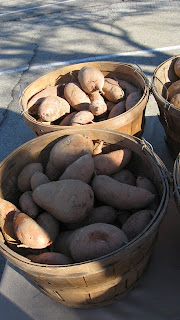


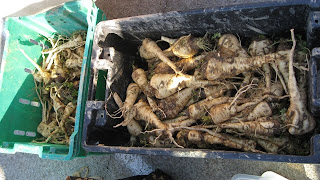

Snow had kept the family from being able to travel down the last few weeks, so this was our first drop since late December, and the patrons seemed joyful, yet ravenous for some fresh vegetables. Running a farm without electricity, or heated/cooled vegetable storage, never lacks for its challenges. There is a big hill one must first traverse to get out of the driveway and if it is iced-over, your chances of success are slim. Why don't you park the van at the top of the hill, you ask?––because that's what I asked. Well, the sweet potatoes and winter squash are at the bottom, in a green house, trying their damnedest not to freeze and ruin. So if you loaded them first, then parked the van at the top of the hill, they'd freeze overnight and ruin. This sort of conundrum is perfectly reflexive of the type of problem-solving dialogue constantly required to run a farm––off the grid or on––and it definitely keeps things interesting. Luckily, this week, January wore its April face.
And look at this food!
Spinach (not pictured)
Kale (not pictured)
Turnips
Sweet potatoes (Golden Nugget)
Butternut squash
Parsnips
Peanuts (Tennessee Red Valencia)
Pasture-Foraged Eggs


Thursday, January 27, 2011
Slow Food

<---- Flood line on barn. The window on the right is my room.
I remember the day we got the pigs––I mean, are you kidding, I was pumped. It was a memorable week all around, really. The flooding in Nashville wasn't limited to Nashville––many of our farming friends in and around our little wonderland in zone 6 were effected. One friend lost all the topsoil he'd ever built––something akin to losing your life's work in a weekend. There was 11 inches of water in my room in the barn and I kayaked for the first time that day, directly out of that barn. That next week we got the pigs.
We raised the pigs in what will become the 2012 garden for the majority of the summer, then moved them into the forest to finish them on acorns, hickory nuts, roots and whatever slop we had around. I spent a lot of time with the pigs, preparing their slop with the help of fermentation, and trying not to get too attached to them––a grave mistake I made with the turkeys. The pigs and turkeys both have wonderful stories, and I will get to those in the coming months. For now, however, onto the eggs...

The hens are out on pasture, they follow behind the cows and lamb in the Management Intensive Grazing System, similar to that outlined by Michael Pollan and Joel Salatin in "The Omnivore's Dilemma." The idea is that you keep the livestock in small paddocks to help concentrate their manure and move them to new grass often. If left to their own devices, cows will happily eat only the grass they like––the candy and ice cream, as Salatin describes it––and hang out in the shady treeline where they will drop their manure and fertilize the living daylights out of their lounge spots, not the pastures. In our system, we limit the space they can fertilize with electrified netting, and move them every 12 hours. Every 3 days we pull our chicken shacks (a roost, a feeder and an egg-mobile) behind. The chickens then spread out the manure in search of nutritious, buggy treats, and we collect the eggs daily.

The plastic on the high tunnel was put up this summer, and it was an intensely hot project. Once done, we plowed and tilled it, then planted spinach,
 chard, carrots, kale, radishes, etc., and kept it cultivated. What irrigation we need comes from a gravity fed pump, and there is no additional heating. I can't say enough about how amazing this project has been, though––not much is growing these days, but I picked my spinach on Monday.
The last piece to this puzzle is the english muffin, which came from Whole Foods, the uncontested birth place of the english muffin. Naturally.
I guess you could call this a summary. A very extreme summary. A small look at the things it took to make my breakfast this morning. The reality is that this sandwich was no less than nine months in the making. Despite how hard the work is, and how hard it is to justify taking the life of a pig (a very controversial topic within myself), I did my best to do all of that justice. If working on a farm did one thing to me (and it did many), it was give my breakfast a story, one I can't help but think about every time I eat absolutely anything,
 Breakfast: a sausage, egg and spinach sandwich on an english muffin. But that doesn't tell any sort of story, now does it?

Tuesday, January 25, 2011
Ist first blaug!

It was about a year ago, almost to the day, that I first met Bugtussle. I flew in from New York, rented a car and drove the 75 miles it is from Nashville to the farm. To my utter amazement, I found the place, then promptly proceeded to destroy my rental car on the road back to the cabin. I'd seen pictures and watched a video about the farm, in an attempt to learn what I could about what I was getting myself into, but only so much about farming can be gleaned from this distance.

It's a ten minute drive from the mailbox to house, that is, if you want your car to survive. On the road back, I passed the skeleton of a high tunnel and a few of the neighbor's cows lounging in the driveway. When I finally arrived, I was greeted by the family I would end up spending the better part of 2010 working alongside. They offered me the internship that next day, and the rest is history, one of which I hope to occasionally cover here.
Yesterday I went back for a visit. I wanted to see the family and the animals and figured I could put in a little work and maybe get a little food out of it. After nine months of naturally-raised vegetables and meat, there is no food that will quite satisfy you the same. I found out my favorite cow died, Darla, love of my life, and my heart broke a little. But death is something you're very intimate with on the farm and life will continue to plug away no matter how sad it renders you. Right now though, it's lambing season, so the life there is even cuter than usual, which helps in the healing process.


I checked in on my musk melon wine, took a sip of maple sap from one of the many jugs hanging on the trees, then ate bacon, sweet potatoes and beans for lunch. When I left, I left with WAY more meat and vegetables than I could possibly eat, including muddy parsnips, leeks, spinach, pork sausage, lamb and pork roasts, kale and eggs, all thanks to the unending generosity of Eric and Cher.
Essentially, with other potent potables, this is my blog––BLAUG!–– as I wish to keep it. It's about farming and about wine and probably occasionally about basketball, but I'll try and be sensitive to the fact that not everyone equates the three. Oh, and I don't speak a lick of german––kein Deutsch––I just like to pretend I do.
Danke,
Fraust

Subscribe to:
Posts (Atom)